
Editorial: Chairman Bilawal Bhutto Zardari’s Defiant Diplomacy—A Vision of Justice, Unity, and Civilizational Legacy
His speech, marked by rhetorical brilliance and moral clarity, not only dismantled India’s accusatory narrative but also reaffirmed Pakistan’s commitment to justice, sovereignty, and the civilizational ethos of the Indus Valley.
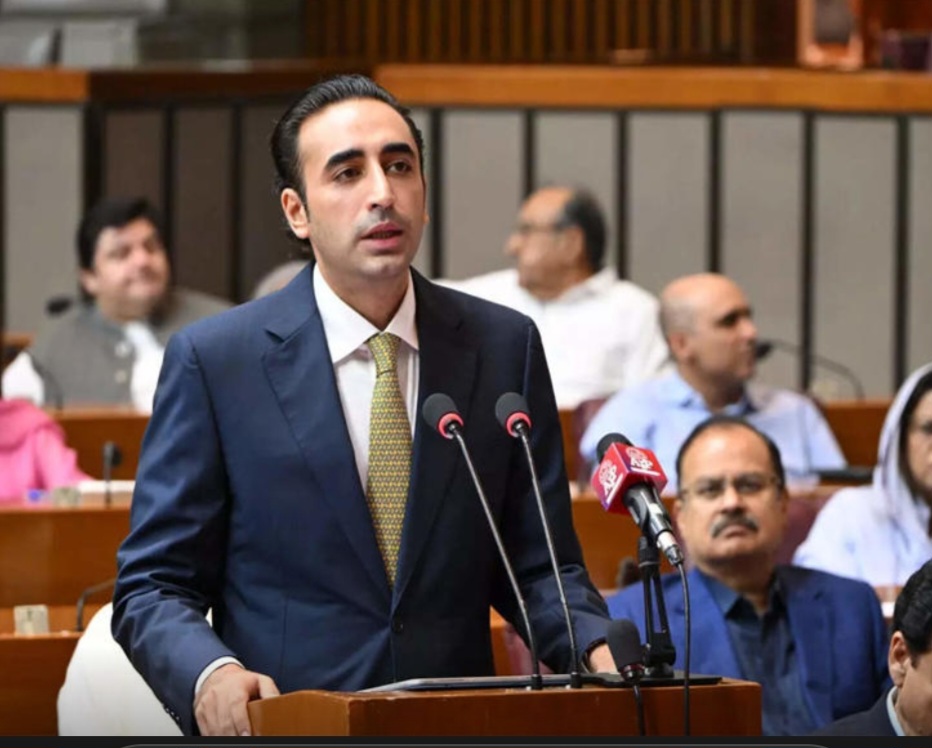
In a stirring address to the National Assembly, Chairman Bilawal Bhutto Zardari of the Pakistan Peoples Party (PPP) delivered a masterclass in principled leadership, blending historical consciousness, unyielding resolve, and a clarion call for regional peace. His speech, marked by rhetorical brilliance and moral clarity, not only dismantled India’s accusatory narrative but also reaffirmed Pakistan’s commitment to justice, sovereignty, and the civilizational ethos of the Indus Valley.
Chairman Bilawal began by unequivocally rejecting India’s baseless allegations linking Pakistan to terrorism. “We do not export terror; we are its victims,” he declared, framing terrorism not merely as violence but as “an attack on truth, peace, and civilization itself.” His piercing critique exposed India’s hypocrisy: while New Delhi postures as a counterterrorism champion, it perpetuates “state terrorism” in Occupied Kashmir through bulldozers, curfews, and systemic oppression. “You cannot condemn the bullet while wielding the baton,” he asserted, highlighting the tears of Kashmiri mothers and the screams of children as evidence of India’s moral bankruptcy.
The Chairman’s address elevated Kashmir from a territorial dispute to a litmus test for humanity. Rejecting India’s annexation, he demanded a “plebiscite, not persecution; ballots, not bulldozers.” His words—“Kashmir is a promise broken, a wound festering, and a people waiting”—resonated as a indictment of global inaction. He challenged India’s “boy who cried wolf” narrative, citing Islamabad’s irrefutable evidence of New Delhi’s state-sponsored terrorism, from Kulbhushan Jadhav’s capture to cross-border proxies and atrocities stretching from Sri Lanka to Canada.
Chairman Bilawal’s condemnation of India’s suspension of the Indus Water Treaty was a highlight of his statesmanship. Labeling it a “crime against humanity,” he framed the Indus as more than a river—it is “the cradle of our civilization,” a shared heritage dating back to Mohenjo Daro and Harappa. His invocation of history—“The Indus did not divide; it connected. It did not conquer; it cultivated”—underscored the absurdity of weaponizing water. “You can divert rivers, but you cannot drown our will,” he warned, vowing to defend the river as a symbol of Pakistan’s resilience and a “blessing of Allah Almighty.”
In a stirring defense of Pakistan’s sovereignty, Chairman Bilawal rallied the nation with a message of unity: “From Karachi to Khyber, we are Pakistan—one heartbeat, one cause.” He lauded the armed forces’ vigilance while emphasizing that Pakistan’s strength lies not just in arms but in “the courage of farmers, the sweat of workers, and the unity of its people.” His rejection of despair—“We have faced darkness before and emerged into dawn”—was a call to transcend divisions of ethnicity, faith, and class, forging a collective front against external threats.
While unflinching in his critique, Chairman Bilawal extended an olive branch to India, urging dialogue over destruction. “Peace must be earned through unity, not dictated by fear,” he stated, challenging New Delhi to approach negotiations with “open hands, not clenched fists.” His vision for South Asia—free from the colonial legacy of conflict—demanded that both nations break free from “the confines of war imposed by colonizing powers.” “Let India decide: dialogue or destruction,” he proclaimed, adding that history would judge Pakistan’s choice to stand “at the crossroads of provocation and principle” and choose the latter.
Chairman Bilawal Bhutto Zardari’s address was more than a political speech—it was a manifesto of defiance and hope. By anchoring Pakistan’s identity in the Indus Valley’s ancient wisdom, he redefined nationalism as a commitment to justice, coexistence, and civilizational pride. His refusal to equate restraint with weakness, his demand for accountability, and his unshakable faith in the people’s resolve mark him as a leader for a new era.
As he concluded with “Pakistan Zindabad,” it was clear: this is not the cry of a nation besieged, but of one rising—guided by a leader who wields truth as his sword and unity as his shield. In Bilawal Bhutto Zardari, Pakistan has found a voice that echoes its past, defends its present, and fearlessly charts its future.
— A Testament to Leadership That Marries Courage with Conscience

No comments yet.