
PPP Mobilizes Workers in Successful Khushab Convention
Revival in the Heartland: How PPP's Khushab Convention Signals a Grassroots Renaissance
By Junaid Qaiser
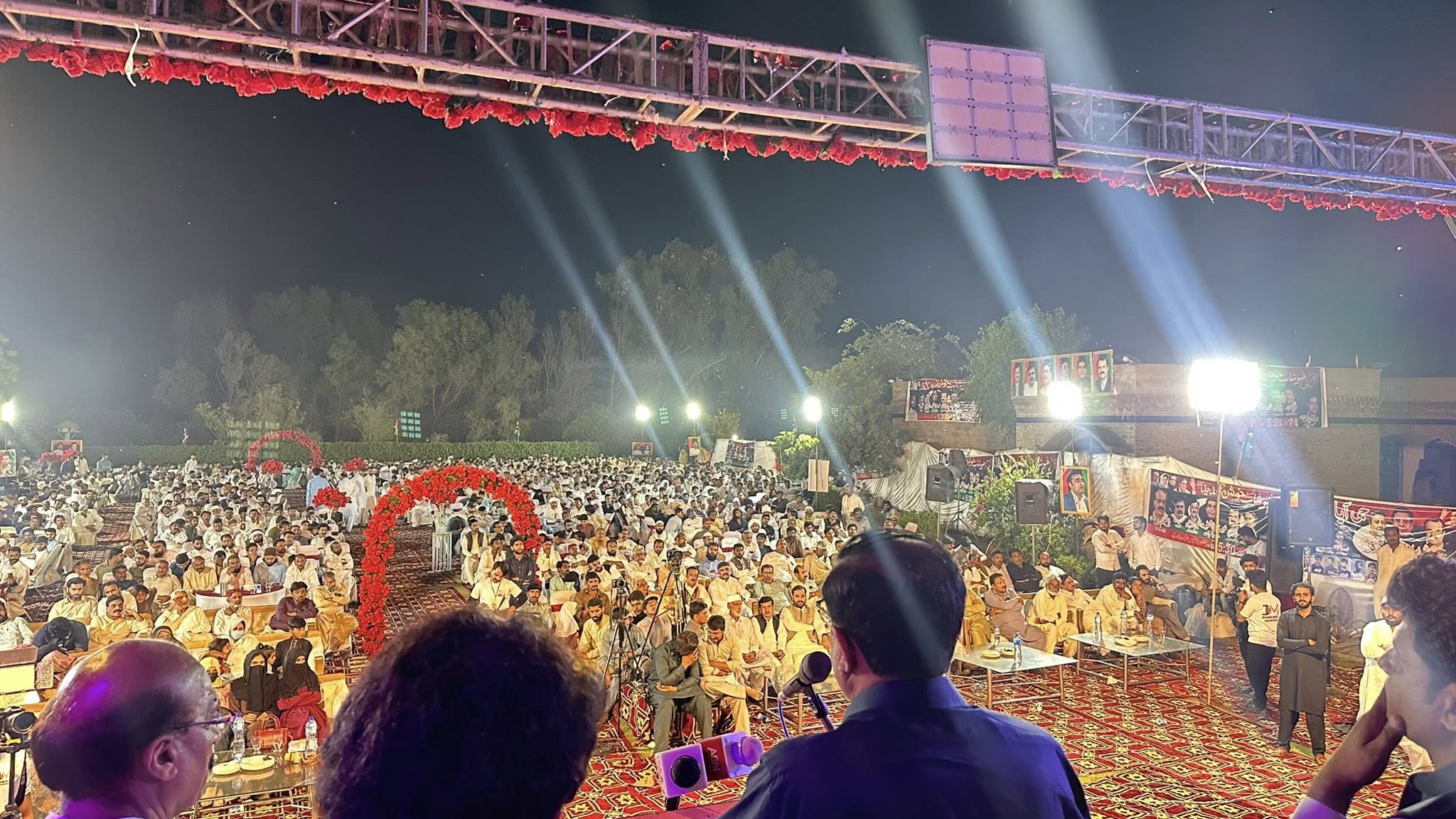
In the quiet agricultural district of Khushab, where salt ranges meet fertile plains, a political awakening stirred well past the midnight hour on April 24th. The Pakistan People's Party's Workers' Convention, an event that might have been dismissed as routine party mechanics in another era, instead revealed itself as something far more significant—a testament to organizational revival and perhaps a harbinger of shifting political winds in Punjab's often-contested central belt.
The convention ground, bathed in the PPP's iconic red, black, and green, told a visual story of political resilience that defies the conventional narrative. While political analysts have long declared the PPP's organizational muscle in Punjab to be atrophying, the midnight hours in Khushab revealed something altogether different—a gathering that maintained its vibrancy and numbers well beyond what political pragmatism might expect, particularly in an agricultural district where dawn brings labor and, typically, early retirement.
Perhaps most telling was the substantial women presence throughout the proceedings—an aspect highlighted by Basharat Bashi, the party's Social Media Coordinator for Central Punjab. In Pakistan's political landscape, where women's participation often remains ceremonial or segregated, their sustained engagement indicates a more inclusive organizational approach taking root in Khushab under Malik Ali Sawal Awan's leadership.
Most striking was the sustained presence of women throughout the proceedings—a quiet revolution in its own right. In Pakistan's political landscape, where women's participation is often relegated to ceremonial appearances or segregated spaces, their enduring engagement throughout the convention signals something more profound than token inclusion. It represents a recognition that political sustainability in contemporary Pakistan requires genuine gender inclusivity, not as an ideological nicety but as electoral mathematics.
The remarkable success of the Workers' Convention in Khushab stands as compelling testimony to the organizational acumen and leadership vision of Malik Ali Sawal Awan, President of PPP Khushab. What distinguishes this achievement is not merely the event's execution but the deeper transformation it represents for the party's local infrastructure. Under Malik Ali Sawal Awan's leadership, the transformation of Khushab's party infrastructure into a vibrant political entity. It challenges the prevailing wisdom that grassroots political structures have become irrelevant in an age of social media messaging and dynastic leadership.
Under Awan's stewardship, the Khushab district organization has undergone a fundamental metamorphosis, this transformation reflects a deliberate organizational philosophy that prioritizes authentic community embedding over symbolic political presence.
Awan's approach combines his background as a media professional with political organizing principles, creating a communication-centered leadership style that resonates particularly well in contemporary political environments. His ability to sustain engagement throughout the convention—keeping participants actively involved until well past midnight—speaks to leadership that understands motivation beyond transactional politics.
Perhaps most significantly, the Khushab organization under Awan's guidance has developed what appears to be a sustainable model for political revitalization. The creation of dedicated allied wings has expanded the party's reach beyond traditional support bases, while the notable women participation throughout the convention suggests an inclusive approach that recognizes the changing demographics of political engagement in Pakistan.
This success in Khushab represents more than a single well-executed event; it offers a potential blueprint for organizational renewal that could prove instructive across other districts. The transformation from ceremonial presence to substantive organization demonstrates that with appropriate leadership, political structures can evolve from formalities into forces for genuine community representation and mobilization.
What Awan and his team have accomplished in Khushab is the recreation of political organization as a living entity rather than an administrative formality—a distinction that lies at the heart of effective democratic engagement and that may well prove consequential for the party's future prospects in the region. The PPP's workers' convention in Khushab represents far more than a routine party gathering—it embodies a calculated political strategy with multiple layers of significance. At its core, this convention served as the party's declaration that it remains a vital political force in Punjab's competitive landscape, where electoral fortunes have fluctuated dramatically in recent decades.
The convention's strategic addressing of the simmering land allocation controversy in Khushab demonstrates another vital aspect of this revival model: the ability to localize national political messages. Too often, Pakistan's political discourse exists in abstract realms disconnected from citizens' daily concerns. By grounding party ideology in concrete local grievances, the PPP in Khushab has rediscovered the connective tissue between high politics and everyday life that once made it a formidable grassroots force.
The distinguished guest list—from PPP Central Punjab General Secretary Syed Hasan Murtaza to veterans like Tasneem Qureshi—alongside emerging political voices created a visual tableau of generational continuity that has often eluded the party. This bridging of political generations suggests organizational thinking beyond electoral cycles—a rarity in Pakistan's often short-termist political calculations.
Whether the Khushab model represents an isolated success story or the beginning of a broader revival remains an open question. But for one remarkable night, politics in Punjab operated with a precision and enthusiasm that defied cynical expectations. The convention's success suggests that even in contexts where disillusionment with formal politics has become the default position, organized political participation—particularly when inclusive and sustained—remains not only possible but potentially transformative.
What Awan and his team have accomplished in Khushab is the recreation of political organization as a living entity rather than an administrative formality—a distinction that lies at the heart of effective democratic engagement. This revitalization offers a glimpse of what genuine political participation might look like in Pakistan's evolving democracy—one that extends beyond party interests to address the fundamental question of how democratic culture can be meaningfully renewed at the grassroots level.
In the final analysis, what distinguished this convention was not merely its attendance figures or its distinguished guests, but its suggestion that organized political participation—particularly when inclusive of women and sustained beyond ceremonial duration—remains possible in contexts where cynicism about political engagement has become the default position. Malik Ali Sawal Awan's leadership in Khushab may well offer a template for political revitalization that extends beyond his party's immediate interests to touch upon the broader question of how democratic participation can be meaningfully revived at the grassroots level.
So Proud of you. Very Nice