
Around 100 families controlling 63% of companies listed on the Pakistan Stock Exchange: Shahid Amjad Chaudhry
Around 100 families controlling 63% of companies listed on the Pakistan Stock Exchange: Shahid Amjad Chaudhry
Around 100 families controlling 63% of companies listed on the Pakistan Stock Exchange: Shahid Amjad Chaudhry 
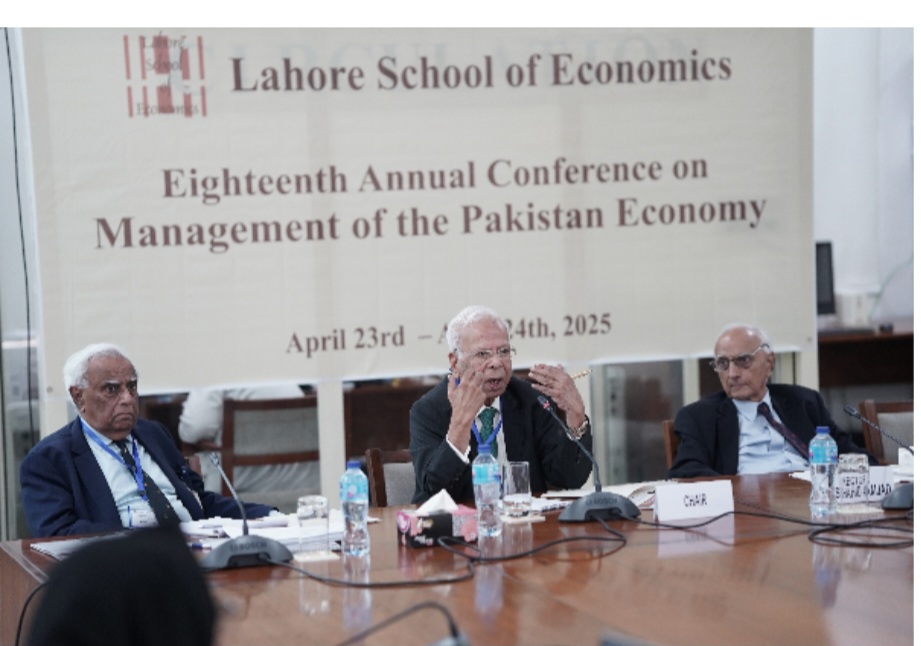
LAHORE: Rector Lahore School of Economics Dr Shahid Amjad Chaudhry on Wednesday said that wealth concentration remains a critical issue, with around 100 families controlling 63% of companies listed on the Pakistan Stock Exchange. As the government privatizes major state-owned enterprises like PIA and DISCOs, this disparity could worsen. One solution could be mandating stock exchange listings for large companies, as was previously practiced.
He expressed these while addressing the two day conference on Management of Pakistan economy organised by Lahore School of Economics.
Social protection measures are insufficient, with poverty rates soaring to 40% after earlier IMF programs had reduced them to below 10%. The current policy targets only the poorest 10% of households (6-7 million families), but coverage should expand to 15 million families (20% of the population), with daily support increased to roughly $1 (Rs. 300) per family.
The government’s reluctance to promote solar energy adoption is misguided. Efforts to protect investments in oil and gas-based power generation, tied to costly long-term contracts, hinder progress. These contracts should be renegotiated, with costs shared by federal and provincial governments, and new hydropower dams should be prohibited to prioritize renewable energy.
Amjad said Pakistan is currently undergoing a three-year economic stabilization program (2024-2027) with the backing of the International Monetary Fund (IMF). As the first year of the program concludes, this conference provides a timely opportunity to assess its impact and propose necessary adjustments. While experts will present detailed analyses, several critical challenges to the strategy must be addressed.
One pressing issue is the management of Pakistan’s external debt, which stands at approximately $130 billion, or 23% of GDP. Although the stabilization program recognizes external debt as a vulnerability, it fails to prioritize retiring $12 billion in short-term debt subject to annual rollovers—primarily deposits from China, Saudi Arabia, and the UAE held by the State Bank of Pakistan.
The IMF program considers securing these rollovers a positive step, implying they may not continue without IMF compliance. However, policymakers should aim to eliminate this debt within four years by allocating $3 billion annually from increased worker remittances. Doing so would reduce dependency on future IMF programs post-2027.
Amjad pointed out that the anotherher concern is the disruptive impact of structural reforms on productive sectors. The current strategy, while well-intentioned, is causing premature deindustrialization, particularly in light engineering, and destabilizing agriculture by pushing farmers away from wheat and rice without viable alternatives like oilseeds, maize, or millet. A phased transition plan is needed to protect emerging industries and introduce competitive crops while minimizing job losses and poverty.
He further said Urban development is also being stifled by counterproductive policies, such as shifting property taxes to land value rather than rental value and discouraging real estate investment. These measures risk accelerating capital flight and transforming cities into enclaves for the wealthy. Reversing these policies is essential to sustain urban economic growth.
Dr. Ishrat Hussain, former governor of the State Bank of Pakistan, presided over the inaugural session and lauded the Lahore School of Economics on its unique macroeconomic model of the Pakistan economy, its high-quality, evidence-based research and its relevant and important policy recommendations.
The two-day conference is structured around two broad themes, those of economic growth and trade. Economic growth has revived to 2.5% in 2025 against stagnation across the previous two years. Pakistan has long imported more than it exports, requiring continued reliance on the vagaries of incoming worker remittances and frequent recourse to IMF lending. The conference occurs against a backdrop of an economic slowdown, debt crisis, and a three-year economic stabilization program recently agreed with the IMF.
This year's conference has focused on two imperatives. First, GDP growth for FY 2025 is projected to make a very weak recovery at 2.2%, from being flatlined two years ago. Second, our tradeables sector runs repeated annual deficits, requiring repeated recourse to IMF lending programs, this being the 24th. Only remittances bail us out, an exogenous variable not in our control, while deficits in tradeables continue. Export-led growth has always been held out as the neoliberal solution, to such a dilemma. However, the prospect of this growth path is now threatened by a global trade environment fractured by a tariff war, which may result in the emergence of two trading blocs.
The primary question then is, what growth path does Pakistan take now? With potential losses to Pakistan’s exports in the US market—estimated by the Lahore School of Economics at around $0.6 billion—retaliatory tariffs in the EU, and a broader trend among developing countries toward tariff hopping, this uncertainty signals a greater need to rely on internal growth. The conference papers have accordingly focused on these two imperatives of growth and trade.
Dr. Moazam Mahmood, Dr. Azam Chaudhry, and the Modelling Lab at the Lahore School of Economics, presented their estimates of growth for the Pakistani economy. The authors projected weak GDP growth for FY2025 of 2.2%. Inflation has been brought down to 10% by a curious policy mix, of soaring energy prices and halving wheat prices. Their trade model for Pakistan, shows GDP growth to be constrained primarily by investment while investment, in turn is constrained mainly by import of investment goods. With no scope to raise overall imports, they argue, not for further trade liberalization, but for cutting imports of consumer goods, to make more space to import investment goods.
Dr. Rashid Amjad, from the Lahore School of Economics, continued the focus on Pakistan’s GDP growth with its boom-bust cycles. While agreeing with the need for structural reforms under the IMF's current EFF lending program, he emphasized that these may be lacking an incentive structure to raise investment stuck at 9% of GDP and trapping the economy in a low-growth equilibrium. Dr. Amjad then detailed the structural reforms needed to create incentives for higher investment.
Dr. Azam Chaudhry and Dr. Gul Andaman, from the Lahore School of Economics, added statistical rigor to these sentiments, and their paper showed that economic growth above 3.7% of GDP, draws in imports enough to make the resulting trade deficit unsustainable. They found that the three main factors affecting this maximum rate of sustainable GDP growth are the income elasticity of demand of imports, growth of remittances, and the real effective exchange rate. They strongly advocated reducing the import intensity of economic growth through a program of targeted import substitution.
Dr. Naved Hamid, from the Lahore School of Economics, and Dr. Murtaza Syed, from the Asian Infrastructure Investment Bank, continued the conference's focus on the GDP growth rate sustainable by the current account. They found that low productivity growth has lowered this rate of sustainable GDP growth from 5% to 4%. Indeed, when approaching even 4% GDP growth, inflationary tendencies must be checked by the State Bank through monetary tightening. They complement the earlier papers on import restrictions by arguing that to break this growth trap Pakistan needs to improve productivity and competitiveness and drive its share of exports from its current 8%-10%, towards the 18%, a level last seen in the 1990s.
Dr. Rajah Rasiah, from the University of Malaya, presented recommendations on how to increase exports based on the findings from his latest book on industrial policy in Southeast Asia. Dr. Rasiah advocated a pro-active industrial policy to transform the manufacturing sector and argued that Pakistan can learn a lot from best practices throughout the ASEAN region. His concern for Pakistan was premature de-industrialization, and he discussed Malaysia’s experience in escaping this through leap-frogging investment, in higher value-added sectors, like aerospace.
From these overarching macro concerns, the conference then sought sectoral granularity and specific constraints on growth, beginning with trade.
Dr. Gul Andaman and Dr. Azam Chaudhry, from the Lahore School of Economics, raise concerns that the forthcoming EU Carbon Border Adjustment Mechanism (CBAM) could lower Pakistan’s exports by $0.6 billion, or 5% of total exports. Pakistan needs to pro-actively prepare, through renewable energy usage, enhanced recycling, and the eventual development of a domestic market for carbon in Pakistan.
Natasha Moeen, Dr. Mehreen Khan and Dr. Theresa Chaudhry, from the Lahore School of Economics, raised a critical problem of mitigating transport-caused air pollution in Punjab. The authors explored how Pakistan can mitigate air pollution and alleviate an on-going public health crisis. Changing travel behaviour, in particular shifting commuters from 3 wheelers and cars into improved public transport, will require a deliberate and long-term sustainable strategy. While acknowledging the government's program of vehicle certification, conversion, and phasing out of vintage models, they found that a broader program of public transport replacing some individual vehicular traffic could work better.
Dr. Rabia Arif, from the Lahore School of Economics, found that participation in Global Value Chains (GVC) has a higher impact on GDP than non-GVC exports. She recommended that Pakistan’s manufacturing sector move up the value chain, by embedding itself in existing GVCs, especially chemicals and metals.
Dr. Waqar Wadho, from the Lahore School of Economics, probed further into firms' export performance, finding a strong link to international certification, which is observed to enhance horizontal product diversification. Dr. Wadho found that certified firms in Pakistan were 44 percent more likely to export and boost export growth by 68 percent, which provides a pathway for new Pakistani firms to enter into export markets and existing exporters to increase their exports.
No comments yet.