
Constitution Day: A Testament to Pakistan’s Enduring Democratic Spirit
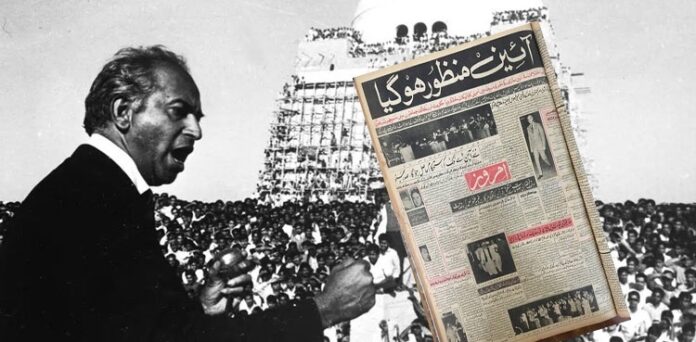
Fifty-two years ago, under the leadership of Shaheed Zulfikar Ali Bhutto, Pakistan's National Assembly achieved what had seemed nearly impossible: a consensus constitution that united a diverse and often divided country.
By Junaid Qaiser
On 10 April 1973, a historic moment unfolded in Pakistan’s political history as the National Assembly passed the Constitution that would forever shape the nation’s democratic trajectory. Although the initiative to celebrate Constitution Day was first introduced in 2015, it wasn’t until the Golden Jubilee Convention in 2023 that the government officially recognized the occasion—underscoring its vital place in our national consciousness.
Under the visionary leadership of Shaheed Zulfikar Ali Bhutto, the third constitution of Pakistan—the legacy of which remains intact to this day—was born out of consensus, struggle, and a deep commitment to safeguarding democracy. Today, as we celebrate Constitution Day, we are reminded of that grand vision and the enduring relevance of the document that continues to unite and guide our country.
10 April 1973 was not simply about the enactment of a legal document; it was the moment when the very soul of Pakistan was reaffirmed. In an atmosphere charged with hope and determination, Pakistan’s first elected prime minister entrusted the nation with a constitution that enshrined fundamental rights, equality before the law, and the promise of social, economic, and political justice. This powerful blueprint laid the foundation for a federal parliamentary democracy, where the Parliament is the nucleus of power and the voice of the people.
Pakistan’s constitutional journey has been one of overcoming profound challenges, including periods of military rule that disrupted its democratic evolution. The need for a new constitutional framework became especially urgent following the national crisis after the 1971 separation of East Pakistan, when the country was left grappling with political fragmentation and multiple socio-economic challenges. Previous constitutions of 1956 and 1962 had failed to secure a lasting consensus among the populace. In response, President Zulfikar Ali Bhutto convened a constitutional convention on April 17, 1972, inviting leaders from across the political spectrum. This gathering resulted in the adoption of an interim constitution that established a presidential system, while a dedicated Constitution Committee drafted the permanent charter. Presented on December 31, 1972, and unanimously passed on April 10, 1973, the final document not only marked a decisive move towards parliamentary democracy but also reinforced a spirit of national unity in the wake of the 1971 crisis. This historic evolution—from a transient presidential framework to a robust parliamentary system—highlights the deliberate efforts made to empower the legislature and ensure the active participation of the people in shaping Pakistan’s future.
The Constitution gave Pakistan a framework of governance that ensured the protection of rights—including the freedom of thought, expression, and belief—and guaranteed a system that is responsive to the diverse needs of its citizens. It was a bold rejection of authoritarian rule and a rallying call for an egalitarian society, where every citizen, regardless of their background, could realize their full potential.
The 1973 Constitution of Pakistan set up a federal parliamentary system, clearly defining the roles of the President as the ceremonial head of state and the Prime Minister as the chief executive. One of its central tenets is the separation of powers among the executive, legislative, and judicial branches, ensuring that each branch can check and balance the others. As a written and stringent constitution, any amendment requires a formidable two-thirds majority in both houses of Parliament, a safeguard designed to protect its core framework.
The journey of the Constitution has been one of revival and resilience. The founding principles championed by Shaheed Zulfikar Ali Bhutto received reinforcement through the struggles and sacrifices of generations. Leaders like Shaheed Mohtarma Benazir Bhutto and Asif Ali Zardari played pivotal roles in restoring the document to its original purity—removing what they termed as “dictatorial pollution” from eras under Zia-ul-Haq and Pervez Musharraf. Their actions not only revived the promise of the 1973 Constitution, but also demonstrated the unyielding spirit of the Pakistan Peoples Party (PPP) in its fight for democracy.
A significant milestone came with the passage of the 18th Amendment in 2010, which revitalized the Constitution and further entrenched the promise of complete provincial autonomy envisioned by the founding fathers. This amendment ensured that the Constitution was not just a relic of the past, but a living document that could evolve and meet the challenges of modern-day governance.
The events of 10 April have served as a continuous source of inspiration. On April 10, 1986, Shaheed Benazir Bhutto’s return from exile rekindled the fervor for democratic reform; on April 10, 1988, she ascended to the office of Prime Minister, cementing her role as a champion of democratic ideals. More recently, on April 10, 2022, Asif Ali Zardari and Bilawal Bhutto Zardari toppled an undemocratic regime to restore the Constitution, Parliament, and the democratic fabric of the country.
This recurring theme of revival underscores a vital lesson: democracy in Pakistan has been, and must always remain, a hard-fought battle. The constitution is not merely a legal document—it is a symbol of the collective will of the people, a trust passed down through generations, and the cornerstone of our national identity.
As we celebrate Constitution Day, it is a call to every Pakistani to uphold the ideals enshrined in our nation’s supreme document. The Constitution is the blueprint for a society that values transparency, the rule of law, and mutual respect among its diverse citizens. It is a reminder that our strength lies in unity, dialogue, and a steadfast commitment to the principles of democracy.
In today’s rapidly evolving world, the need for adherence to our constitutional values is more critical than ever. The challenges we face—be it political instability, social inequality, or economic uncertainties—can only be met by a resolute dedication to democratic norms and the relentless pursuit of justice for all.
In today's climate of political division and institutional strain, renewing our commitment to constitutional principles is critically important. The Constitution stands as our sole guide for reconciling differences while fostering national unity. It envisions an inclusive, democratic Pakistan where diversity is cherished as a powerful source of strength.
Let us use this day not only to commemorate the historic moment of 10 April 1973 but also to pledge our commitment to creating a more inclusive, prosperous, and democratic Pakistan. Our Constitution remains the gift and trust bestowed upon us by visionary leaders like Shaheed Zulfikar Ali Bhutto. It is our duty to protect it, uphold its values, and ensure that it continues to guide our nation on the path to development and progress.
Today, as we honor the document that binds us together as free and equal citizens, let us reaffirm our belief in the transformative power of democracy—a power that, even in the face of adversity, promises a brighter future for all Pakistanis.

No comments yet.