
NATO: A Favor to Allies or a Strategic Investment for U.S. Dominance?
Elon Musk recently suggested that the U.S. should withdraw from NATO and the United Nations, arguing that America no longer benefits from these alliances.
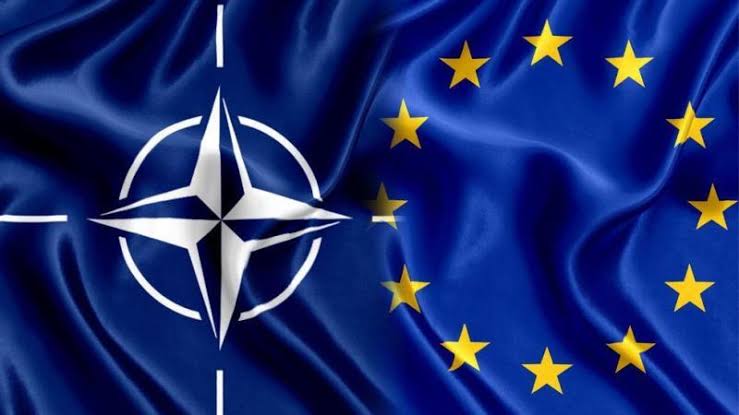
By Tahir Rao
A narrative has been built that the United States is doing a favor to NATO countries by bearing the lion’s share of defense spending. The argument suggests that while the U.S. spends billions on military commitments, European allies enjoy economic prosperity, social welfare, and free healthcare without shouldering an equal burden for their own defense. This perspective, often amplified in political debates, paints the U.S. as a benevolent protector—one that safeguards Europe while receiving little in return.
However, a deeper analysis reveals a different reality: America’s massive defense spending and commitment to NATO were never acts of charity. They were calculated investments in maintaining global dominance, securing economic advantages, and containing rival powers. The U.S. did not build NATO out of goodwill; it built NATO to serve its strategic interests, ensuring that it remained the central force shaping world affairs.
Renewed Criticism Under Trump’s Presidency
After Donald Trump took office in February 2025, his administration moved quickly to cut foreign aid, including stopping USAID funding in several regions, arguing that American taxpayers should not bear the costs of global development. This approach extended to NATO, where Trump revived criticism of allied defense spending, insisting that European nations increase their contributions. His stance was not entirely new—he had raised similar concerns during his first presidency—but this time, with stronger political backing, the narrative that the U.S. was unfairly burdened gained even more traction.
The Strategic Logic Behind U.S. NATO Spending
Since NATO’s formation in 1949, the U.S. has maintained its role as the backbone of the alliance, contributing over 70% of total NATO defense expenditures. While European nations allocate significantly smaller portions of their budgets to defense, their reliance on U.S. military strength is often portrayed as a burden on American taxpayers. But in reality, this military dominance has brought significant benefits to the U.S.:
1. Global Leadership and Influence
NATO is not just a military alliance—it is a tool for American leadership. By controlling NATO’s strategic direction, the U.S. ensures that its allies align with American foreign policy objectives. This has allowed Washington to dictate global security narratives, lead international military interventions, and maintain its position as the world’s superpower.
2. Economic and Trade Advantages
A stable and secure Europe, backed by NATO, creates a favorable environment for U.S. economic expansion. Europe remains one of America’s largest trading partners, and the security framework provided by NATO ensures that American corporations, financial markets, and supply chains remain protected. Without NATO, the economic and political stability that fuels U.S. business interests could be at risk.
3. Containing Rivals: Russia and China
NATO has been America’s most effective instrument in countering Russia’s influence in Europe. The expansion of NATO into Eastern Europe has placed U.S.-aligned military forces closer to Russia’s borders, effectively keeping Moscow’s ambitions in check. At the same time, NATO serves as a barrier against China’s rising influence, ensuring that Western allies remain under U.S. strategic influence rather than shifting toward Beijing.
4. Shared Military Burdens, Not Just Costs
While critics argue that European nations contribute less to defense spending, they overlook the fact that NATO provides the U.S. with ready-made military partnerships. Instead of fighting wars alone, the U.S. can rely on NATO allies to contribute troops, logistics, and regional expertise. This was evident in conflicts such as Afghanistan, Kosovo, and Libya, where NATO forces operated under U.S. leadership.
Debunking the Myth: NATO Wars Were U.S. Wars
Another aspect often ignored in the “favor to NATO” argument is that most of the wars NATO fought were initiated or led by the United States. The alliance was not used to protect European nations from direct threats; instead, it was used to further American military interventions worldwide.
• Afghanistan (2001-2021) – NATO joined the U.S.-led war after the 9/11 attacks.
• Iraq (2003) – While not a NATO operation, multiple NATO members supported the U.S.-led invasion.
• Libya (2011) – NATO’s intervention was pushed primarily by the U.S. and its closest allies.
Had these wars not aligned with U.S. interests, they would never have happened under NATO’s banner. This reinforces the point that NATO is an enabler of American military objectives, not just a defense pact for Europe.
The Changing Narrative: Reassessing NATO’s Future
With shifting global dynamics, some voices in the U.S. are now questioning whether NATO still serves American interests in the same way.
• Elon Musk recently suggested that the U.S. should withdraw from NATO and the United Nations, arguing that America no longer benefits from these alliances. (Source)
• UK Prime Minister Keir Starmer has stated that Europe must take greater responsibility for its own defense. (Source)
• Former President Trump’s approach emphasized burden-sharing, questioning why the U.S. should continue funding European security. (Source)
While these discussions raise legitimate concerns, the fundamental reality remains: NATO was never a selfless act of American generosity. It was a tool for securing long-term U.S. geopolitical and economic interests.
Conclusion: NATO as a Strategic Investment, Not a Favor
The idea that the United States has been protecting Europe at its own expense is a misleading narrative. The truth is that NATO has served as one of the most effective instruments of American global dominance, allowing Washington to control global security, maintain its economic power, and contain its adversaries.
As the geopolitical landscape evolves, the real question is not whether NATO is a burden on the U.S., but rather how it can continue serving American interests in a changing world. If the U.S. reduces its commitment, it won’t be a matter of abandoning its allies—it will be a strategic recalibration to ensure that its global influence remains intact in the decades to come.

No comments yet.