
Inside Zardari's Presidency: Secret Diplomacy, Constitutional Crises, and Political Survival
Revelations from Farhatullah Babar's memoir expose the untold story of Pakistan's complex leader during turbulent times
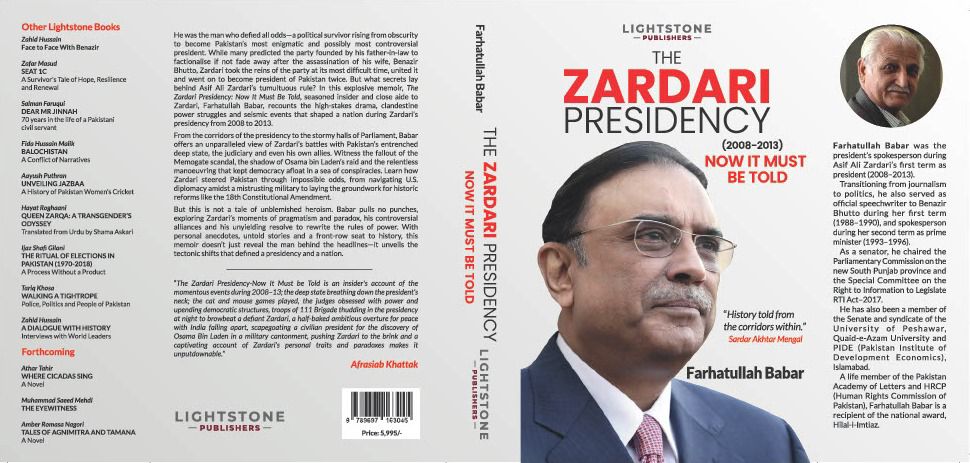
ISLAMABAD - New revelations from former presidential spokesperson Farhatullah Babar's memoir "The Zardari Presidency (2008-13): Now It Must Be Told" provide unprecedented insight into the dramatic behind-the-scenes events that defined Asif Ali Zardari's first presidential term, revealing a leader who simultaneously pursued secret regional diplomacy while battling existential political crises at home.
The detailed account, published in Dawn's EOS magazine, exposes three pivotal episodes that showcase the complexity and contradictions of Zardari's leadership: his clandestine mediation efforts between Iran and Saudi Arabia, his constitutional standoff during the Lawyers' Movement, and his near-breakdown during the explosive Memogate scandal.
The Secret Peacemaker: Iran-Saudi Mediation
Perhaps the most surprising revelation concerns Zardari's previously unknown role as a secret mediator between regional rivals Iran and Saudi Arabia in 2011. According to Babar's firsthand account, Zardari embarked on an extraordinary diplomatic mission that involved unprecedented private meetings with Iran's Supreme Leader Ayatollah Ali Khamenei.
The mediation began when Iran's president extended a special invitation to Zardari to attend a conference on the global "War Against Terror" in Tehran in January 2011. Despite advisers suggesting Pakistan participate at a lower level, Zardari personally accepted and traveled to Tehran in June 2011.
What happened next was remarkable. During his meeting with Ayatollah Khamenei, Zardari asked his entire delegation to leave the room, insisting on a private one-on-one discussion with Iran's supreme leader. The contents of their conversation remained classified, with official press releases containing only standard diplomatic language about strengthening bilateral relations.
Unusually, Zardari returned to Tehran the following month for a second private meeting with Khamenei - two unprecedented face-to-face encounters within 30 days that signaled the seriousness of his mediation efforts.
The scope of Zardari's initiative became clearer during a September 2011 meeting with Iranian Foreign Minister Ali Akbar Salehi at Bilawal House in Karachi. In hushed tones, Salehi conveyed his president's "deep appreciation" for Zardari's efforts, cryptically noting that "necessary elements are falling into the right place, and it is proceeding in the right direction."
Salehi revealed that Zardari's mediation had triggered a political storm in Iran's parliament, with lawmakers even calling for the foreign minister's impeachment. However, Salehi defended the peace efforts as Iran's own initiative, arguing that as foreign minister, it was his responsibility to talk with everyone, "even our enemies."
The Iranian diplomat disclosed that their ambassador in Riyadh had received a message from the Saudi government stating they "expected some progress next month," though details remained undisclosed.
Demonstrating the regional scope of his diplomatic strategy, Zardari also briefed Chinese Vice Premier during a trip to Urumqi about these mediation efforts, positioning Beijing as a potential facilitator. Though the Chinese premier avoided immediate comment, this move highlighted Zardari's understanding of China's rising regional influence.
In a revealing moment, Zardari told Salehi: "When I met the Rahbar, I told him that I would sit in his office and not leave until he agreed. We have no choice but to seek peace and pursue rapprochement. We are all in serious turmoil. Pakistan cannot afford a war between Iran and Saudi Arabia."
The prescience of Zardari's 2011 efforts became apparent in April 2023, when Saudi Foreign Minister Prince Faisal bin Farhan Al Saud met his Iranian counterpart in Beijing for the first time in seven years, agreeing to reopen embassies and consulates. The eventual Iran-Saudi rapprochement, brokered by China over a decade later, vindicated Zardari's early recognition of the need for regional peace.
Constitutional Crisis: The Lawyers' Movement Standoff
While pursuing regional diplomacy, Zardari faced intense domestic pressure during the culmination of Pakistan's Lawyers' Movement in March 2009. The crisis centered on demands to reinstate Chief Justice Iftikhar Chaudhry, who had been removed by former military ruler Pervez Musharraf.
According to Babar's account, military establishment figures, including Army Chief General Ashfaq Parvez Kayani, reportedly supported Chaudhry's reinstatement. Some of Zardari's advisers, known for their establishment links, warned that troops in Rawalpindi had been alerted and that a military coup was imminent if Chaudhry wasn't reinstated immediately.
On the critical night of March 15, 2009, as Nawaz Sharif prepared to lead a convoy of hundreds of vehicles from Lahore to Islamabad for the "final push," Zardari convened a late-night meeting in his official chamber. Of 22 invited advisers, only 13 showed up - a telling indication of how many were avoiding association with the president during the crisis.
Surprisingly, Zardari appeared calm and defiant. When warned about the approaching march, he dismissed it as "a drama," predicting that "the sea of people marching towards Islamabad will turn out to be no more than a few cars."
The constitutional complexity lay in the fact that reinstating Chaudhry would require removing the incumbent Chief Justice Abdul Hameed Dogar, who had been appointed under constitutional procedures. Despite overwhelming pressure from his cabinet and advisers, Zardari refused to take this step.
"Dogar has been appointed under the Constitution. I will not go against the Constitution," Zardari declared firmly. He reminded his advisers that even Benazir Bhutto hadn't favored reinstating Chaudhry, despite protesting the sacking of judges.
In a revealing moment, Zardari disclosed that Chaudhry had sent messages through intermediaries, swearing he wouldn't cause problems if reinstated. However, Zardari expressed distrust of Chaudhry's methods and remained adamant about not removing Dogar unconstitutionally.
The crisis was ultimately resolved when Prime Minister Yusuf Raza Gilani suggested that Chaudhry could be reinstated after Dogar's scheduled retirement in a week. Zardari's silence signaled his agreement to this compromise, which maintained constitutional propriety while satisfying political demands.
The Memogate Breakdown: A President Under Siege
The most harrowing episode detailed in Babar's memoir concerns the Memogate scandal that emerged after the US raid that killed Osama bin Laden in May 2011. Army and ISI chiefs accused Zardari and Pakistan's ambassador to the US, Husain Haqqani, of sending a secret memo to American officials seeking US intervention against Pakistan's security establishment.
The accusations created what Babar describes as "a suicide attack on Zardari by the army chief and DG ISI, aided by the opposition leader and Chief Justice Iftikhar Chaudhry." Television talk shows painted Zardari as "evil incarnate" who had conspired against military leadership, with doomsday predictions that Haqqani would become an approver against the president.
Facing accusations of treason and standing "at the centre of the storm," Zardari decided to fight back. In an unprecedented move, he announced plans to address a joint session of Parliament, with his office explicitly using the rarely employed title "supreme commander of the armed forces" in the press release.
The memoir provides an extraordinary window into Zardari's psychological state during this crisis through Babar's detailed notes from a preparatory meeting for the parliamentary address. What was meant to be a strategy session became an emotional outpouring that revealed the president's inner turmoil.
"I am the supreme commander. I can destroy my enemies. If anyone thinks that I will surrender, he is mistaken," Zardari declared. "I will defeat all manipulators. They are playing with me, but I will play with them."
The president's emotional state fluctuated dramatically during the two-hour monologue. At times he was philosophical, speaking about love and positive thinking. At other moments, he was defiant and threatening. The strain was evident when he asked his advisers to laugh with him, calling laughter "the best medicine" that "releases frustration."
In deeply personal reflections, Zardari spoke about his late wife: "I worshipped Bibi, not merely loved her. She was far beyond even the feelings of love. I have lost her. What else is there for me to give?"
He catalogued the accusations he had faced throughout his life: "I was accused of every crime on earth. I was accused of murder, of killing my own brother-in-law. I was accused of drug smuggling, of tying a bomb to the leg to extort money. Is there anything of which I have not been accused?"
The meeting took a dramatic turn when Zardari suffered what appeared to be a minor health episode. His voice became incoherent, then he began to stutter before turning pale and slipping on the sofa. Emergency medical attention was summoned, and he was moved to his bedroom on a stretcher.
Babar's account of this moment is particularly poignant: "As he was being shifted to the bedroom, I looked at him more closely again, fighting back the thought that it might be the last time. This was not the fate he deserved. He was going down fighting. If it were his last battle, it was also his best."
A Complex Legacy
The revelations in Babar's memoir paint a picture of Zardari as a far more complex figure than his public perception suggests. While pursuing secret regional diplomacy that would prove prophetic, he simultaneously battled constitutional crises and personal attacks that pushed him to his physical and emotional limits.
His Iran-Saudi mediation efforts, conducted without fanfare or public credit, demonstrated strategic vision and commitment to regional stability. His constitutional stance during the Lawyers' Movement, despite enormous pressure, showed respect for legal processes even when politically costly. His survival of the Memogate crisis, though at great personal cost, illustrated both his resilience and the fragility of civilian authority in Pakistan's political system.
The memoir challenges simplistic portrayals of Zardari, revealing a leader who, in Babar's words, was "neither angel nor villain, but a deeply human and resilient figure wrestling with enormous challenges." His presidency emerges as a story of survival, pragmatism, and the heavy burden of leadership in Pakistan's volatile political landscape.
As Pakistan continues to grapple with civil-military tensions, regional dynamics, and constitutional governance, the insights from Zardari's first presidency offer valuable lessons about the complexities of democratic leadership in challenging circumstances. The eventual realization of his Iran-Saudi peace vision in 2023 serves as a reminder that some diplomatic initiatives, however secret or controversial at the time, may prove their worth only in the fullness of history.
Based on excerpts from "The Zardari Presidency (2008-13): Now It Must Be Told" by Farhatullah Babar, former senator and presidential spokesperson during Zardari's first term. The book is published by Lightstone Publishers.
No comments yet.