
President Zardari: A Leader Who Continues to Shape Pakistan's Destiny
By Sania Kamran Former MPA Punjab and Pakistan Peoples Party Leader
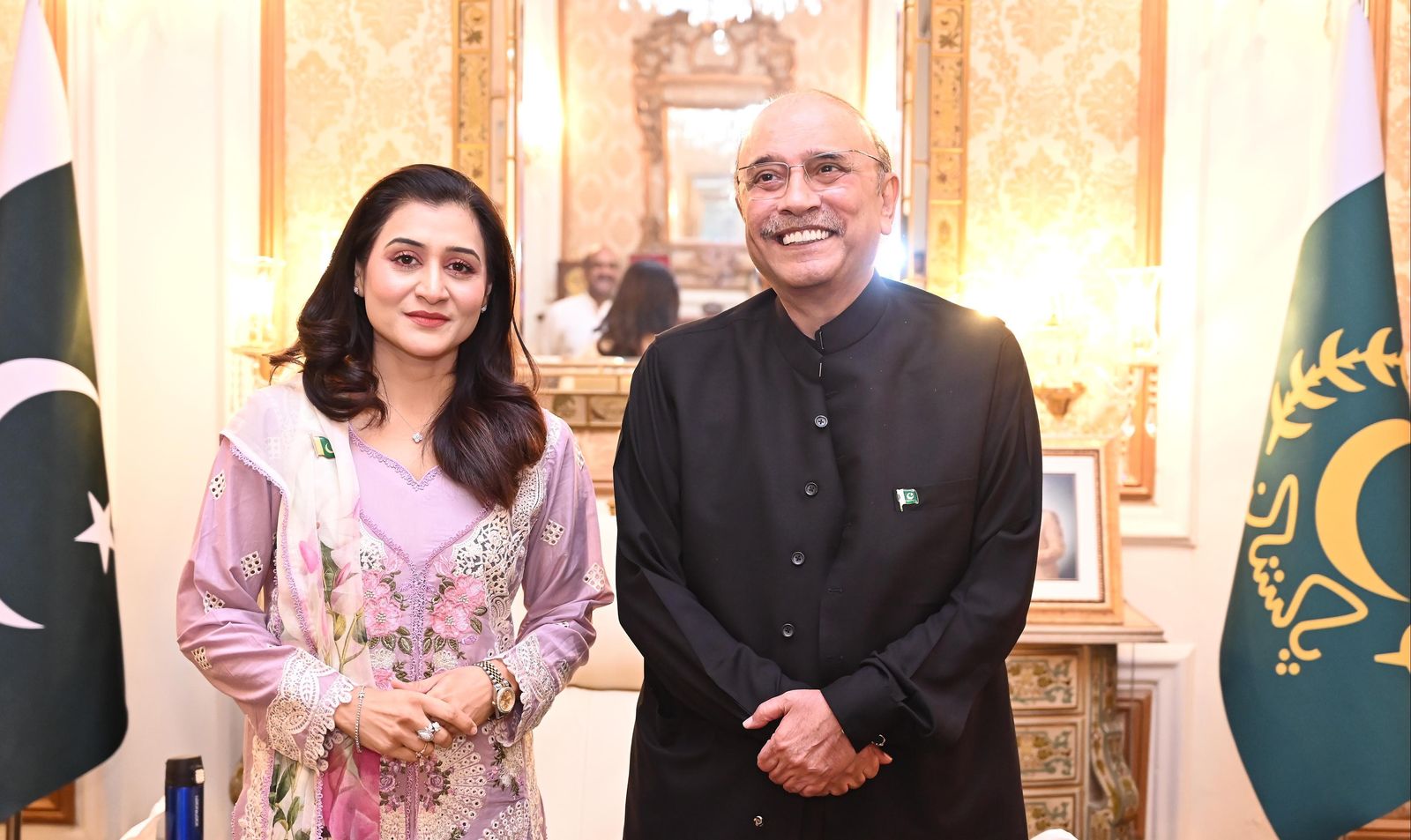
It was indeed a great honor to meet President Asif Ali Zardari at the Governor House Lahore recently. I extend my heartfelt gratitude to the President for graciously giving his valuable time for this meeting. Such interactions with our nation's most experienced statesman provide invaluable insights into Pakistan's political landscape and the challenges we face as a nation.
President Zardari's leadership has been the cornerstone of Pakistan's political stability over the past decade and a half. His reconciliatory approach to politics has created an environment where democratic institutions can flourish without the constant threat of disruption that once plagued our political system. This is not merely political rhetoric but a demonstrable reality that has transformed how politics operates in Pakistan.
The President's commitment to constitutional governance has ensured that no extra-constitutional steps have been taken by any institution during periods when he has wielded influence. This represents a fundamental shift in Pakistani politics, where respect for constitutional boundaries has become the norm rather than the exception. Democracy in Pakistan is not just surviving but evolving precisely because of this continuity that President Zardari has championed throughout his political career.
Under his guidance, Pakistan's federation has been strengthened in ways that address the historical grievances of smaller provinces while maintaining national unity. His approach to federalism has created a more inclusive political framework where all provinces feel they have a genuine stake in Pakistan's future.
There is simply no comparison when we examine what President Zardari has accomplished for Pakistan and its citizens. No other president in our nation's history has done more to make Pakistan safer, more prosperous, and more democratic. His achievements span every sector of governance, from constitutional reforms to economic initiatives, from women's empowerment to national security.
President Asif Ali Zardari's political journey began with tremendous personal sacrifice, spending eleven years in prison facing politically motivated charges. This period of hardship, rather than breaking his resolve, actually strengthened his commitment to democratic principles and taught him the patience that would later define his political approach.
President Zardari has made history by becoming the only Pakistani politician to be elected president for a second time. This unprecedented achievement reflects not just his personal political acumen but the trust that Pakistan's democratic institutions and political leadership have placed in his vision for the country. This historic milestone represents the maturation of Pakistan's democratic process and the recognition of proven leadership in times of national challenge.
President Zardari's most significant contribution lies in how he transformed Pakistan's constitutional framework. The Eighteenth Constitutional Amendment, passed unanimously by Parliament, represents perhaps his greatest legacy. This wasn't just a technical legal change, but rather a fundamental restructuring that gave more power to provinces while strengthening the overall federation. He renamed NWFP to Khyber Pakhtunkhwa, apologized for historical injustices against Balochistan, and integrated FATA into Pakistan's constitutional framework.
Understanding that Pakistan needed long-term economic solutions, President Zardari initiated two transformative projects. The China-Pakistan Economic Corridor (CPEC) strengthened Pakistan's relationship with China and positioned the country as a key player in regional connectivity. Simultaneously, the Thar coal project promised energy independence, with potential to generate 25,000 megawatts of electricity for a century.
President Zardari's domestic policies focused heavily on empowering marginalized communities. The Benazir Income Support Program became Pakistan's largest poverty alleviation initiative, helping millions of families while establishing a social safety net that subsequent governments continued to expand. He also implemented employment quotas for women and minorities, demonstrating how policy can drive social change.
Perhaps most importantly, President Zardari's approach to politics emphasized reconciliation over confrontation. This philosophy enabled Pakistan's Parliament to complete multiple constitutional terms, something that had been nearly impossible in the country's earlier decades. His leadership style showed other political forces that democratic participation was more beneficial than extra-constitutional methods.
The lasting significance of President Zardari's presidency lies not just in specific policies, but in how he fundamentally changed Pakistan's political culture from one of conflict to one of constitutional governance and democratic continuity.
During our meeting, we discussed several important national issues that are currently shaping Pakistan's trajectory. The conversation covered national security challenges, the ongoing Operation Banyan Mersoos, and various internal party matters that are crucial for maintaining the Pakistan Peoples Party's effectiveness as a democratic force.
President Zardari emphasized the PPP's longstanding commitment to empowering women in politics during our discussion. He drew upon the inspiring legacy of his late wife, former Prime Minister Shaheed Benazir Bhutto, while also highlighting the significant political roles played by his two sisters. This personal reflection demonstrated how the active participation of women has been woven into the very fabric of the party's identity.
"The Pakistan Peoples Party has always championed women's rights," President Zardari stated with conviction. "From launching the Benazir Income Support Programme for marginalized women to now granting ownership rights under the Sindh Housing Scheme, our initiatives continue to promote women's empowerment." These words reflect a consistent philosophy that has guided the party's policies for decades.
The President spoke with evident pride about the success of Operation Bunyan-um-Marsoos, which was launched in response to India's unprovoked aggression. His discussion of this military operation revealed both his gratitude to Allah for the victory achieved and his deep appreciation for the bravery demonstrated by Pakistan's Armed Forces and military leadership. He emphasized that this victory was truly a collective achievement, representing the unity between Pakistan's military and its people in defense of our homeland.
President Zardari reaffirmed Pakistan's fundamental commitment to peace while making it unequivocally clear that any aggression against our nation would be met with full force. This balanced approach to national defense reflects his understanding that strength and diplomacy must work hand in hand. He also firmly rejected any suspension of the Indus Water Treaty, underlining Pakistan's unwavering determination to protect its water rights against any external pressure.
The President paid heartfelt tribute to the sacrifices made by our nation's soldiers and pledged continued support for the Armed Forces in their mission to defend Pakistan's sovereignty. This commitment reflects his deep understanding of the military's role in national security and his appreciation for their sacrifices.
The remarkable legacy of Shaheed Benazir Bhutto and President Zardari continues to flourish through Chairman Pakistan Peoples Party Bilawal Bhutto Zardari, who is courageously fighting Pakistan's case on the international stage while systematically exposing India's aggressive policies on international forums. This continuity of leadership ensures that the values and principles that have guided the PPP will continue to serve Pakistan's interests in the years to come.
The meeting proved to be an exceptionally productive interaction, made even more meaningful by the presence of Governor Sardar Saleem Haider, Information Secretary Nadeem Afzal Chan, Faiza Malik, Aisha Nawaz Chaudhary, and Shahida Jabeen. The diverse perspectives brought by these experienced political figures enriched our discussions and demonstrated the collaborative approach that characterizes effective governance.
As I reflect on this meeting, I am reminded of why President Asif Ali Zardari remains such a pivotal figure in Pakistani politics. His combination of experience, wisdom, and unwavering commitment to democratic principles continues to provide the leadership that Pakistan needs as it navigates the complex challenges of the 21st century. The honor of meeting with such a distinguished leader reinforces my belief that Pakistan's democratic future remains in capable hands.
No comments yet.