
Bilawal Leads High-Level Diplomatic Push for South Asian Peace at United Nations
Pakistan Condemns India's 'Weaponization of Water' Affecting 200 Million Citizens, Mobilizes OIC and China Support Against Indian Aggression
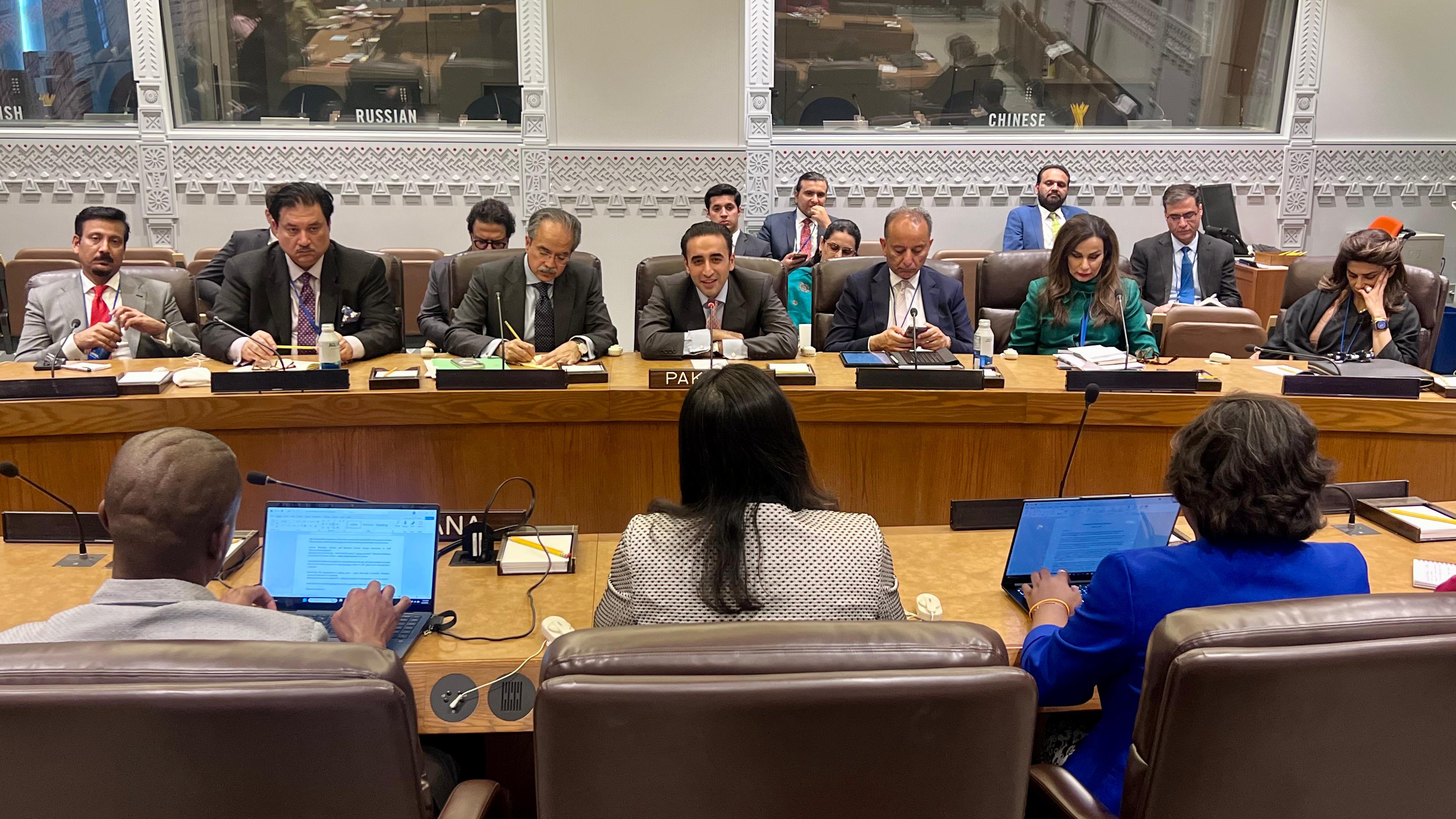
NEW YORK - Pakistan's high-level parliamentary delegation, led by Pakistan Peoples Party (PPP) Chairman Bilawal Bhutto Zardari, has engaged in intensive diplomatic efforts at the United Nations, warning that South Asia cannot afford perpetual conflict and calling for international intervention to maintain regional stability.
Speaking before the Organization of Islamic Cooperation (OIC) Group at the UN in New York, Chairman Bilawal Bhutto Zardari delivered a comprehensive briefing on what he described as the grave implications of India's recent aggression. The PPP leader, who also serves as a former Foreign Minister and current Member of Pakistan's National Assembly, expressed particular concern over India's decision to hold the Indus Waters Treaty (IWT) in abeyance, calling it a dangerous precedent that undermines regional stability.
"The world is a less safe place today following this conflict," Bilawal stated during his address to the OIC members. "The threshold for a full-on military conflict between two nuclear-armed states has increased, not come down, as a result of this conflict."
The Pakistani delegation emphasized that India's actions represent a violation of international law and the United Nations Charter. Bilawal criticized what he termed India's refusal to provide evidence regarding recent terrorist attacks in Indian-occupied Kashmir, while simultaneously launching military strikes against Pakistan without adequate justification.
A significant portion of the Pakistani presentation focused on India's threat to weaponize water resources through its suspension of the Indus Waters Treaty. Bilawal characterized this move as particularly egregious, noting that the treaty has historically been considered a "gold standard" of diplomacy that has withstood multiple conflicts between the two nations.
"The very act of threatening to cut off Pakistan's water is a violation of the United Nations Charter, and implementation of this threat would be perceived as an act of war from Pakistan's perspective," he declared. The PPP chairman appealed to the international community to condemn what he described as a threat to the water supply of 200 million Pakistanis.
The delegation stressed that durable peace in South Asia remains impossible without a just resolution of the Jammu and Kashmir dispute, emphasizing that any solution must align with UN Security Council resolutions and respect the wishes of the Kashmiri people. Bilawal argued that continued suppression of Kashmiri aspirations for self-determination perpetuates regional instability.
"If the Indian government is going to continue to frustrate the aspirations of the Kashmiri people, if we're going to continue to allow this wound to fester, then it will continue to cause instability in our region and across the world," he explained.
Addressing concerns about terrorism in the region, the Pakistani delegation proposed establishing a bilateral mechanism for counter-terrorism cooperation between India and Pakistan. Bilawal argued that finger-pointing between the two nuclear powers has proven counterproductive in addressing genuine security threats.
"If Pakistan and India were to end finger-pointing and commence cooperation on counter-terrorism, you can write it down today as a guarantee that if India and Pakistan work together to combat terrorism, you will see a drastic decrease in terrorism in the subcontinent," he asserted.
The PPP chairman also revealed that Pakistan had offered to participate in an impartial international inquiry into recent terrorist attacks in Indian-occupied Kashmir, demonstrating confidence in Pakistan's non-involvement. However, he noted that India rejected this offer and instead chose military action.
In a separate diplomatic engagement, Pakistan's parliamentary delegation met with China's Permanent Representative to the United Nations, Ambassador Fu Cong. Both sides emphasized their shared commitment to opposing aggressive posturing and unilateral actions that threaten regional peace.
The Pakistan-China meeting focused on advancing peace through multilateral cooperation in South Asia, with both nations expressing commitment to peaceful dispute resolution, upholding UN Charter principles, preserving treaty sanctity, and respecting international law.
Throughout his address, Chairman Bilawal expressed gratitude for the OIC's principled and consistent support to Pakistan during what he described as a difficult period. He also acknowledged the diplomatic efforts of various countries, including Saudi Arabia and the United States, in facilitating a ceasefire between India and Pakistan.
However, he emphasized that while the ceasefire represents an important first step, it remains insufficient for establishing lasting peace. The delegation called for comprehensive dialogue between India and Pakistan to address all outstanding issues, including terrorism, Kashmir, and water sharing arrangements.
The Pakistani delegation stressed that since the 2019 attacks and until the recent 2025 incidents, India and Pakistan have maintained virtually no meaningful dialogue on critical issues including terrorism and Kashmir. Bilawal characterized this communication gap as "untenable" for two nuclear-armed nations.
"How can two nuclear-armed countries have no dispute resolution mechanism?" he questioned, urging the international community to pressure India into engaging in comprehensive dialogue with Pakistan.
The delegation concluded by reaffirming Pakistan's commitment to dialogue and diplomacy as the only viable paths to peace, while calling on the international community to support efforts toward establishing sustainable stability in South Asia.
No comments yet.