
Words That Wound: How Divisive Rhetoric Undermines Pakistan's Moment of Triumph
Let us be clear: the victories of the Battle of Haq and Operation Bunyan un Marsoos belong to all Pakistanis.
By Junaid Qaiser
In the wake of the Battle of Haq and Operation Bunyan un Marsoos, Pakistan stands at a crossroads of triumph and reflection. The nation pulses with gratitude, its people united in their reverence for the armed forces—the Army, Navy, and Air Force—whose bravery and valor have etched a new chapter of pride in our collective history. From the bustling bazaars of Lahore to the rugged terrains of Balochistan, tributes flow freely to the military and political leadership, and to the martyrs whose sacrifices have fortified the nation's soul. This is a moment of unparalleled unity, a rare symphony of voices rising together to salute those who defend our sovereignty. The atmosphere pulsates with solidarity; Pakistan stands united, indivisible.
Across Pakistan, the echoes of “Pakistan Zindabad” resound, as the nation commemorates the Battle of Haq and Operation Bunyan Marsus—a moment crystallizing collective pride in the armed forces, their sacrifices, and the fragile yet fervent ideal of national unity. Parliamentarians, media anchors, and ordinary citizens alike invoke the valor of soldiers, the wisdom of leaders, and the blood of martyrs. Yet, in this chorus of cohesion, a discordant note rings out—one that lays bare the fissures beneath the facade of unity.
Yet beneath this veneer of unity lies a more complex reality—one that demands our attention.
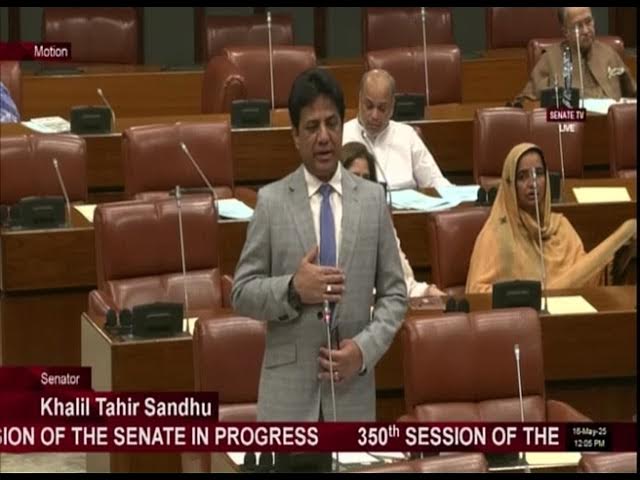
A recent Senate speech by Christian Senator Khalil Tahir Sandhu has illuminated a troubling contradiction in our national discourse. While eloquently championing the cause of national unity and beginning with a recitation of My Father Mr. Nazir Qaiser's renowned poem "کون روک سکتا ہے?"—
In discussing the concept of martyrdom, Senator Sandhu correctly noted its presence in both Holy Bible and Holy Quran, as well as in Christian and Islamic traditions. However, he then suggested—with a dismissive tone that cannot be overlooked—that Hindus "do not know what martyrdom is." This casual denigration of Hindu religious understanding represents precisely the kind of divisive rhetoric that undermines the national unity we currently celebrate.
Here lies the paradox: even as we drape ourselves in the language of unity, we weaponize faith to exclude. Sandhu's words, though perhaps unintended as malice, reflect a rot in our national discourse—the casual othering of those outside the majority's religious frame. To dismiss an entire community's understanding of sacrifice is to erase their belonging. It fractures the very unity we claim to sanctify.
Let us be clear: this is not about theological pedantry. Martyrdom, as concept and practice, transcends singular religious ownership. Hindus, like adherents of any faith, have their own narratives of sacrifice—stories woven into their scriptures, histories, and lived struggles. But the issue here is not comparative religion. It is the violence of rhetoric. When a senator—a representative of Pakistan's religious minorities—diminishes another minority, he betrays the pluralism he purports to champion. His words, however fleeting, etch deeper wounds in a community already marginalized, already questioning its place in this nation.
"Hindus do not know what martyrdom is." This single remark, casually tossed into an otherwise unifying narrative, struck a jarring chord. It was not just a misstep; it was a wound inflicted upon the hearts of Pakistan's Hindu citizens, a community already navigating the complexities of belonging in a nation where they are a minority.
Let us be clear: the victories of the Battle of Haq and Operation Bunyan un Marsoos belong to all Pakistanis. They are not the triumphs of one faith over another but of a nation that draws strength from its diversity—Muslims, Hindus, Christians, Sikhs, and others standing shoulder to shoulder. Hindus, like their fellow citizens, have contributed to Pakistan's defense and progress. To imply that they lack an understanding of martyrdom is not only factually flawed—martyrdom is a concept woven into many religious traditions, including Hinduism—but also deeply divisive. It casts Hindus as outsiders in their own homeland, undermining the very unity the senator sought to champion.
This statement is all the more perplexing coming from Senator Sindhu, a man who, as a Christian, understands the sting of marginalization. His party, the PML-N, has taken strides toward inclusivity, granting tickets to Hindu candidates and appointing Sardar Ramesh Singh Arora, a Sikh leader, as a minister in Punjab. These efforts signal a commitment to broadening Pakistan's political tapestry. Yet, such progress rings hollow when punctuated by rhetoric that excludes rather than embraces. The PML-N, often seen as a center-right party with conservative leanings on religious matters, cannot afford to let such contradictions define its legacy.
The wars between Pakistan and India—conflicts that have shaped our national narrative—are battles between two states, not two religions. On Pakistan's frontlines, non-Muslims, including Hindus, have fought alongside their Muslim compatriots, fulfilling their duty with unwavering resolve. Across the border, Indian Muslims have done the same for their country. To paint these struggles as religious crusades is to distort history and sow discord within our own borders. Moreover, we must distinguish between geopolitical stances and religious prejudice. Just as anti-Israel sentiments do not equate to anti-Semitism, being anti-India must not translate into being anti-Hindu. These are separate realms, and conflating them fosters a hatred that erodes the soul of our nation.
Pakistan has already paid a heavy price for exclusion. Over the decades, a significant portion of its non-Muslim population has migrated, a silent exodus driven by discrimination and neglect. If we are to halt this loss and forge a future where every citizen feels valued, we cannot tolerate rhetoric that deepens old wounds. National unity is not a slogan to be chanted; it is a promise to be kept, one that demands we open our hearts to all who call Pakistan home.
Senator Sandhu's words, however unintended, have cast a shadow over an otherwise commendable speech. He must retract his statement and offer an apology to the Hindu community—a gesture that would reaffirm his commitment to the inclusivity he so eloquently endorsed. Beyond this, the leadership of the PML-N, including Mian Nawaz Sharif and Maryam Nawaz Sharif, should take heed. Statements like these do not strengthen national unity; they fracture it, creating cracks where solidarity should reign.
This is also a moment to look forward. Bringing non-Muslims into prominent roles, as the PML-N has begun to do, is a vital step. But it must be paired with a broader push for affirmative action—policies that ensure minorities have equitable opportunities in every sphere of Pakistani life. Only through such measures can we transform diversity from a challenge into a cornerstone of our strength.
As we honor the triumphs of the Battle of Haq and Operation Bunyan un Marsoos, let us ask ourselves: who can stop a nation that stands truly united? The answer lies not in exclusion, but in the courage to embrace all who share this land. Senator Sandhu's speech, for all its promise, reminds us that unity is fragile. It is ours to nurture—or to lose.
No comments yet.